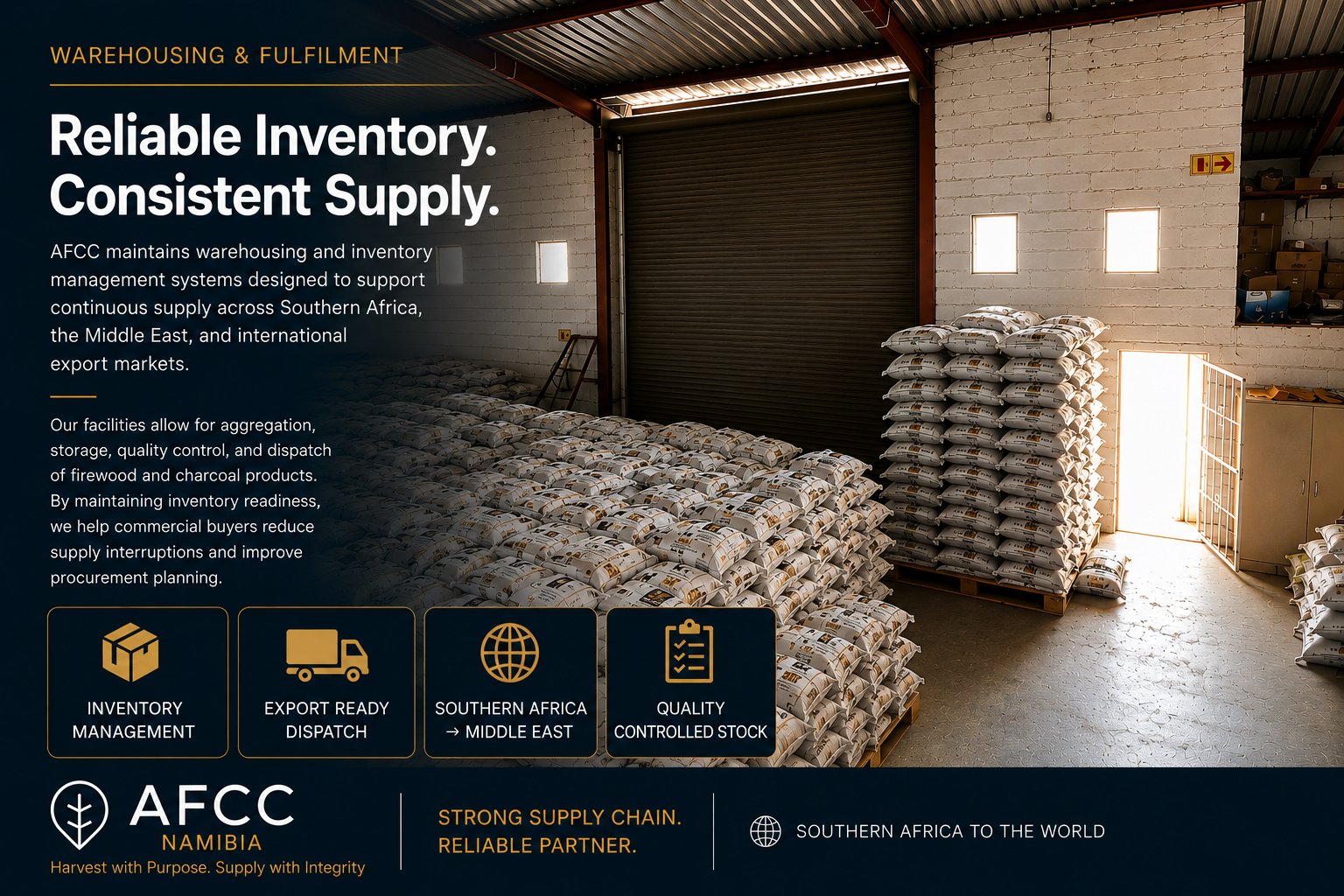
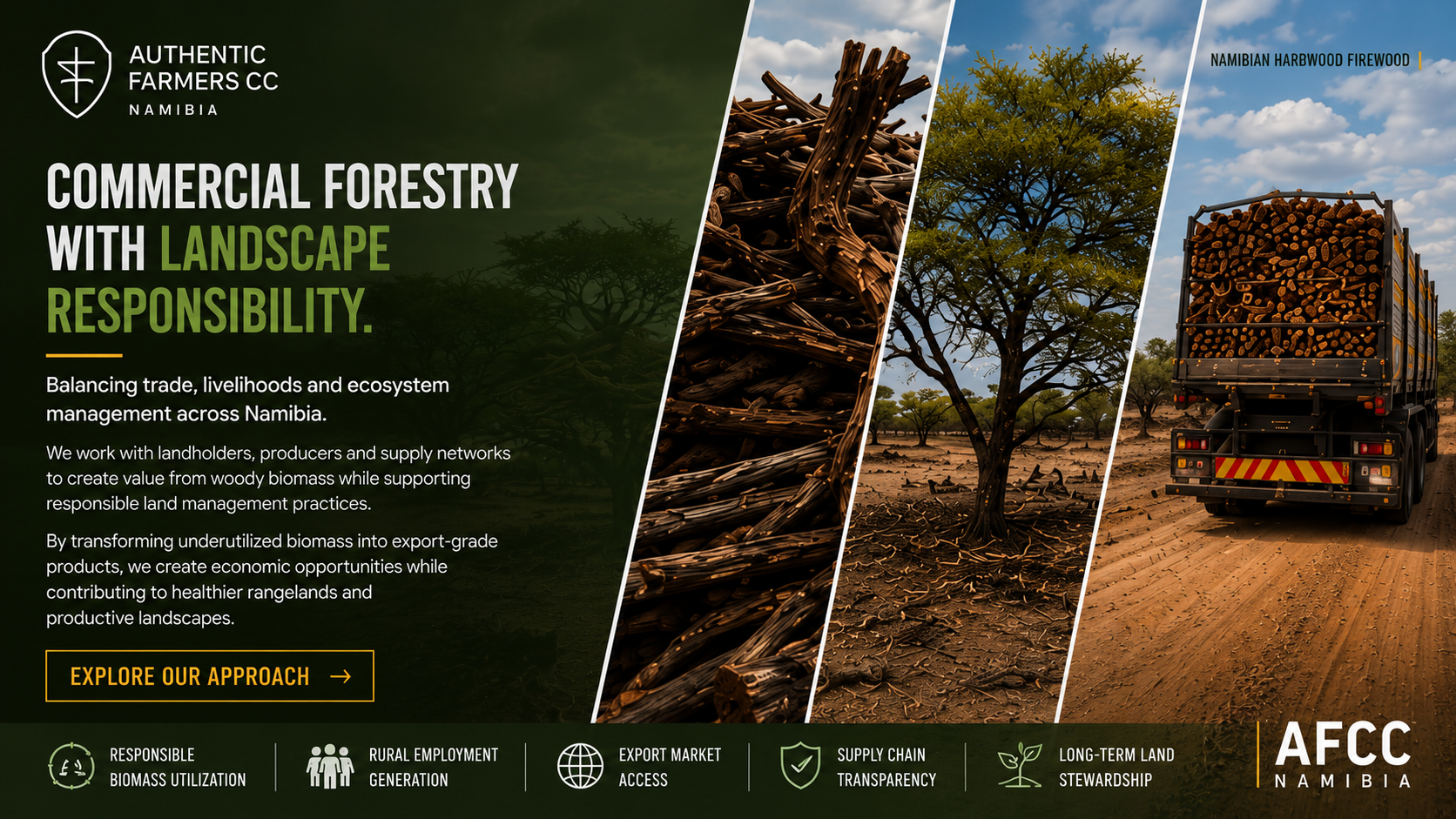
We supply firewood and charcoal to international markets, harvested through responsible bush management in Namibia. Every shipment begins with landscape restoration and supports the communities who steward the land.
“We harvest with purpose and supply with integrity — restoring the land that sustains us, and delivering fuel you can depend on.”
Our work begins with bush-encroached rangeland in Namibia. Through selective thinning and community-based harvesting, we restore degraded landscapes while producing high-performance biomass fuels for discerning international buyers.
Every species we supply is selected for combustion performance, traceability, and responsible harvesting. Our firewood and charcoal are produced from bush-thinning operations that restore Namibian rangeland.

Dense, slow-burning firewood from indigenous Namibian species. Harvested through bush-thinning programmes that restore grassland and improve rangeland productivity.
Dense hardwood charcoal with high calorific value, low ash content, and extended burn time. Produced from encroacher bush species, kiln-processed for consistent quality.
Our firewood is sourced from indigenous hardwood species native to Namibia’s arid and semi-arid landscapes. These species produce exceptionally dense wood with slow, even burn characteristics valued by fuel markets worldwide. All harvesting takes place within regulated bush-thinning programmes designed to restore degraded rangeland.
One of Southern Africa’s most valued firewood species. Extremely dense heartwood producing long-lasting coals with intense, steady heat. Slow-growing and selectively harvested from bush-encroached areas.
A prolific encroacher species that responds well to management through thinning. Dense wood structure with strong heat output. Harvesting Sicklebush directly contributes to rangeland restoration and grass recovery.
Also known as Black Thorn, one of Namibia’s primary bush encroachers. Produces reliable, consistent firewood with good burning properties. Its removal opens grassland for grazing and biodiversity recovery.
Our charcoal is produced from hardwood encroacher bush species using controlled carbonisation. The result is dense, long-burning lump charcoal with high fixed carbon content and minimal ash. Each batch is traceable to its harvesting area and species composition.
Produces clean-burning charcoal with excellent calorific value. The dense wood structure of White Acacia translates into charcoal that holds heat well and burns evenly, preferred by barbecue and hospitality markets.
Known for intense heat and long burn duration. Red Acacia charcoal produces minimal sparking and low ash, making it suitable for commercial food preparation and domestic retail markets.
Terminalia sericea, known locally as Mushara, produces dense, heavy charcoal lumps with reliable performance characteristics. Recognised for consistent burn quality and well-suited to blended or single-origin product lines.
Namibia’s extreme arid conditions produce hardwoods of exceptional density. Low rainfall and intense sun create slow-growing species with concentrated energy — the foundation of our fuel quality.
Dense hardwood structure delivers concentrated energy per kilogram, ensuring efficient heat output across all applications.
Clean combustion with minimal residue. Reduces cleanup for commercial and domestic users and indicates high-quality carbonisation.
Slow, even combustion sustained over long periods. Suitable for hospitality, catering, and applications requiring consistent heat without frequent refuelling.
Controlled processing and species selection ensure consistent quality across batches. Buyers receive reliable fuel characteristics shipment after shipment.
Our supply chain begins with an ecological problem and turns it into a resource. Bush encroachment threatens millions of hectares of Namibian rangeland. Selective thinning restores these landscapes while producing the biomass fuels we export.
Across Namibia, indigenous bush species have expanded beyond their natural density, suppressing grassland, reducing biodiversity, and degrading rangeland. This process, driven by historical land management changes and climate shifts, affects an estimated 26 to 45 million hectares.
Selective bush thinning — removing excess woody biomass while retaining ecologically valuable trees — restores the balance between bush and grassland. Thinned areas recover grass cover, improve soil moisture retention, and support greater species diversity.
We work within permitted harvesting areas and follow species-specific management guidelines. No old-growth or protected trees are removed. Each consignment is traceable to its area of origin, ensuring full supply chain transparency.
Bush harvesting is labour-intensive work. Our supply chain provides sustained income to rural communities in Namibia, where formal employment opportunities are limited. We view these relationships as long-term partnerships.
Harvesting, processing, and logistics create direct employment in rural areas where economic opportunities are scarce. Our operations provide consistent, seasonal income that supports families and local economies.
We work with community groups who manage and carry out harvesting on their own land or within communal conservancies. The people closest to the resource benefit directly from its responsible use.
By linking rural communities to international fuel markets, we create an economic incentive for continued landscape stewardship. Income from bush harvesting encourages long-term land management rather than short-term exploitation.
Community harvesters receive training in sustainable thinning practices, safety, and quality standards. Building local capacity strengthens both the supply chain and the communities within it.
Supply chains should leave people and landscapes better off than they found them. Community partnerships are not a side benefit of our operations — they are central to how we work. The reliability of our supply depends on the wellbeing and commitment of the people who steward the land.
Namibia’s arid climate produces some of the densest hardwood species in Southern Africa. Combined with a transparent regulatory environment and established export infrastructure, Namibia is a reliable origin for long-term fuel supply partnerships.
Low rainfall and intense sunlight produce slow-growing trees with exceptionally dense wood. These harsh conditions create the high-energy biomass that makes Namibian firewood and charcoal prized in international markets.
With tens of millions of hectares affected by bush encroachment, Namibia holds one of the largest underutilised biomass resources in Southern Africa. Responsible harvesting is both ecologically beneficial and commercially viable at scale.
Well-developed road and port infrastructure supports regular containerised exports. The Port of Walvis Bay provides efficient access to European, Middle Eastern, and Asian markets with competitive freight logistics.
Namibians have used indigenous wood fuels for generations. Deep familiarity with species characteristics and burning properties informs every stage of harvesting and production — grounding modern export operations in traditional land knowledge.
We work with importers, distributors, BBQ fuel suppliers, hospitality buyers, and institutional procurement teams. If you are looking for a reliable, long-term source of premium biomass fuels, we welcome your enquiry.
Tell us about your requirements and our sales team will respond with product specifications, packaging options, and supply terms. We aim to reply within two business days.
Complete the form and our team will follow up with product and supply details.